
Achieving Sustainability

Scaling up stewardship – the Chinese way

China has a distinctive corporate landscape. Most of the A-shares market by value is made up of state-owned enterprises and companies with a large single shareholder are common. Does this mean engaging with Chinese companies requires a customised approach?

Key takeaways

  • The Chinese regulatory environment for stewardship is generally supportive and as sustainable investments increase in China we expect more policy-level clarity to encourage further progress.
  • A customised stewardship approach combining engagement and proxy voting can enable minority shareholders to influence sustainability agendas typically dominated by management and significant shareholders.
  • Shareholder activism on sustainability proposals could gain traction in the future but requires collective efforts from both domestic and global institutional investors.

The regulatory environment for stewardship is generally supportive in China. Over the past year, the revised Company Law has added new provisions to strengthen corporate governance rules and protect shareholder rights. Additionally, the Asset Management Association of China published guidance on proxy voting1 as early as in 2012, and new stewardship guidelines are being finalised by the Insurance Asset Management Association of China,2 both of which can encourage domestic institutional investors to adopt a more proactive stewardship approach. However, there is no formal stewardship code in place in mainland China; while in Hong Kong the Principles of Ownership guidance3 have been in place since 2016.

Regulatory momentum is encouraging Chinese institutions to sign up to the UN Principles for Responsible Investment – China is one of the UN PRI’s fastest-growing markets globally in recent years4 – and to participate in collaborative investor initiatives such as Climate Action 100+ and the newly established China Climate Engagement Initiative.

It is also positive to see more domestic investors publicly announce votes against management – evidence of a more “activist” mindset. But challenges exist. Domestic and global investors have different priorities on material sustainability topics, which can limit collaboration on stewardship practices, resulting in less effective communications with management teams.

Unique corporate environment

We explore four unique characteristics of the China A-shares market5 and how these call for a customised approach to stewardship:

State-owned enterprises play a big role

Central and local state-owned enterprises (SOE) represent 26% of all listed companies in China’s A-shares market, accounting for 51% of gross market capitalisation.6 However access to senior management of these SOEs can be challenging: they tend to be less present at investor roadshows and the collective roles minority shareholders can play are limited. Engagement with SOEs requires persistence and continuous dialogue to influence and build mutual trust. We focus on sharing best practices with SOEs and recognise the role they play in economic and social development.

Large single shareholders dominate

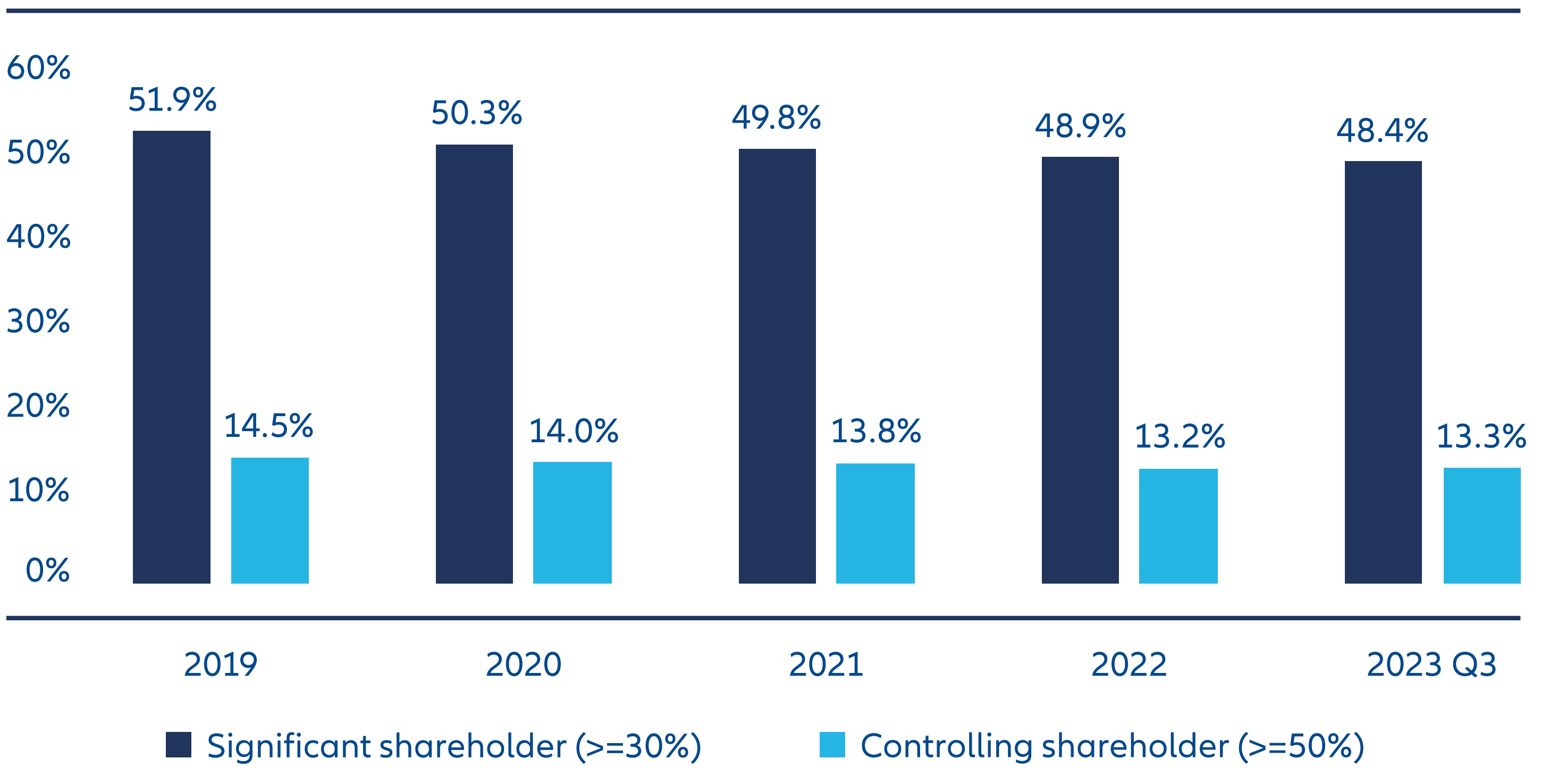
The number of controlling or significant shareholdings among A-shares companies has gradually declined in the last five years – see Exhibit 1. However, large single shareholders holding over 30% of shares continue to dominate. This can crowd out institutional investors who want to exercise influence via proxy voting approaches in general meetings. We actively monitor shareholder proposals that could give controlling shareholders undue influence, including items such as providing loans and guarantees to affiliated companies, related party transactions and capitalisation proposals. We seek to engage with listed companies ahead of annual general meetings (AGMs) and extraordinary general meetings (EGMs) if contentious agenda items are tabled, and we use our engagement findings to feed into subsequent proxy voting decisions.

Exhibit 1: High proportion of listed A-shares companies with controlling or significant shareholders

Source: Wind data, compiled by Allianz Global Investors, 30 September 2023

Individual investors weigh heavily

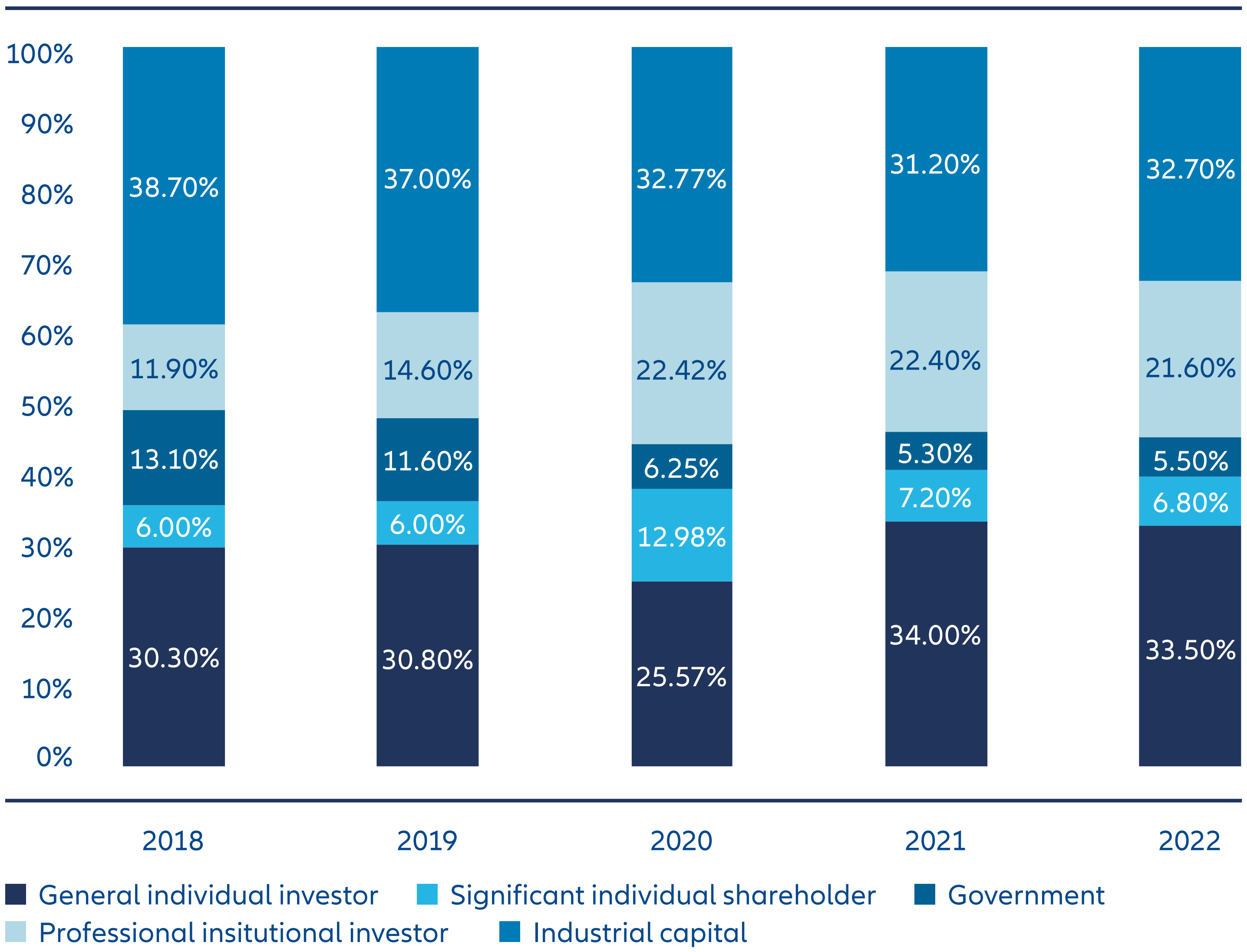
Over the past five years, general individual investors7 have held an average of more than 30% of the total shares in the China A-shares market (see Exhibit 2). However, without the resources of institutional investors, they may struggle to access companies’ published materials in a timely way or speak with companies on topics of concern. To allow more investors to make informed decisions on companies’ actions, we encourage firms to publish proxy voting materials in advance and with granularity, such as providing comparison tables on key company by-law amendments. Additionally, we require virtual general meetings to be easily accessible to all investors.

Exhibit 2: Shareholding structure of the China A-shares market

Source: Wind data, compiled by SWS Research, June 2023

There’s only a low penetration of foreign investments

Foreign investors continue to own only a fraction of China A-shares companies. Over the last five years, China A-shares assets owned by foreign entities have remained below 5% (as a percentage of market capitalisation).8 Additionally, foreign shareholdings are capped at 30% and some strategically important companies are not accessible to foreign investors. With the accelerating opening-up of the China equity market, sustainability leadership could be achieved, and we actively participate in regulatory consultations and collaborative initiatives to drive measurable outcomes.

Our approach

Our stewardship approach for the Chinese market leverages our global stewardship strategy, combining engagement activity focused on clear outcomes with thorough proxy voting analysis.

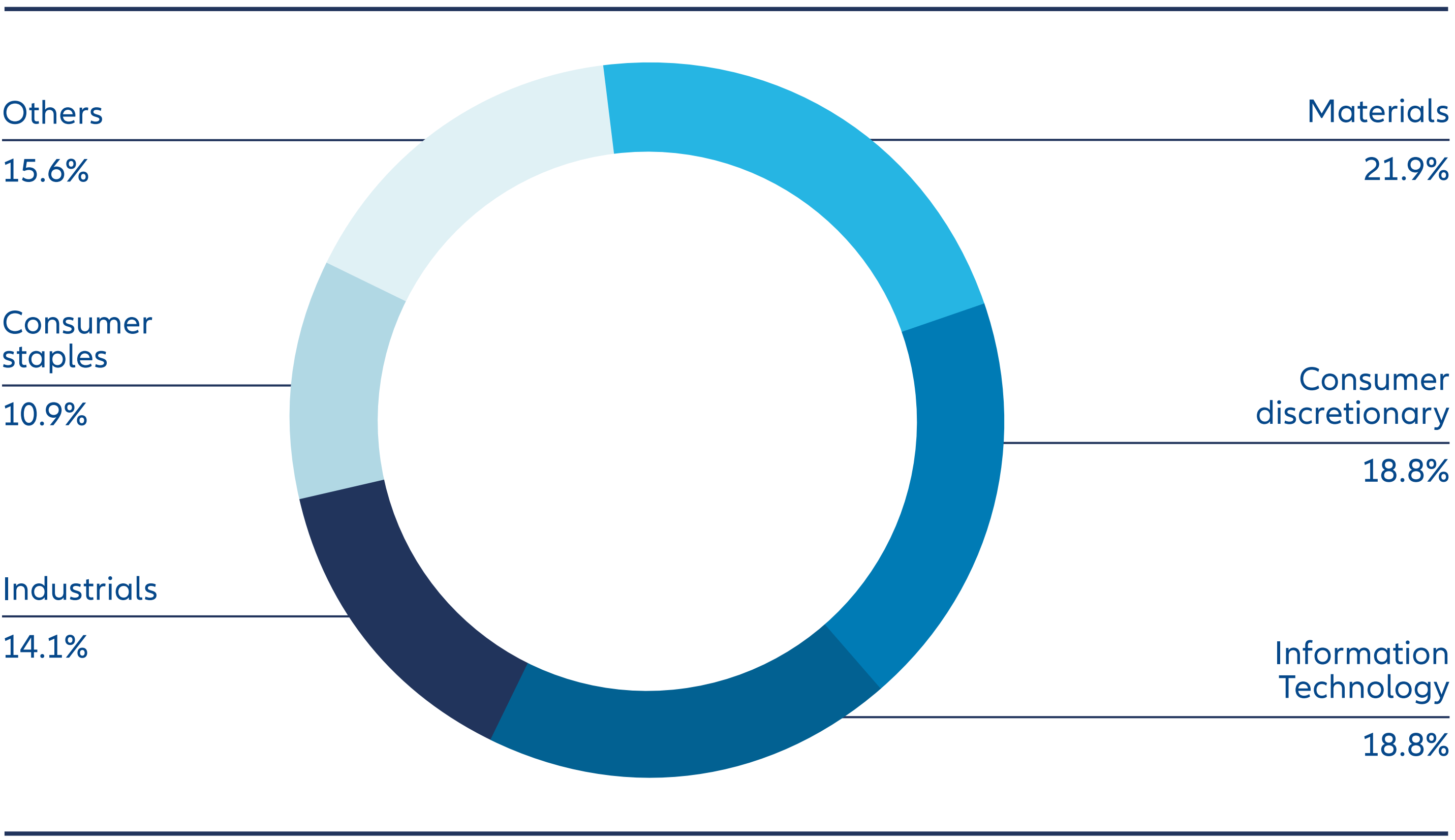
In 2023, we conducted 64 deep-dive discussions with Chinese companies across a wide range of sectors. Climate change and greenhouse gas emissions, corporate governance practices and executive compensation were the top three topics for our engagements. Human Rights & Community Relations, and Transparency and Disclosure have also accounted for a significant proportion of our engagements.

Exhibit 3: AllianzGI engagements with Chinese companies by sector

Source: Allianz Global Investors, as at 31 December 2023

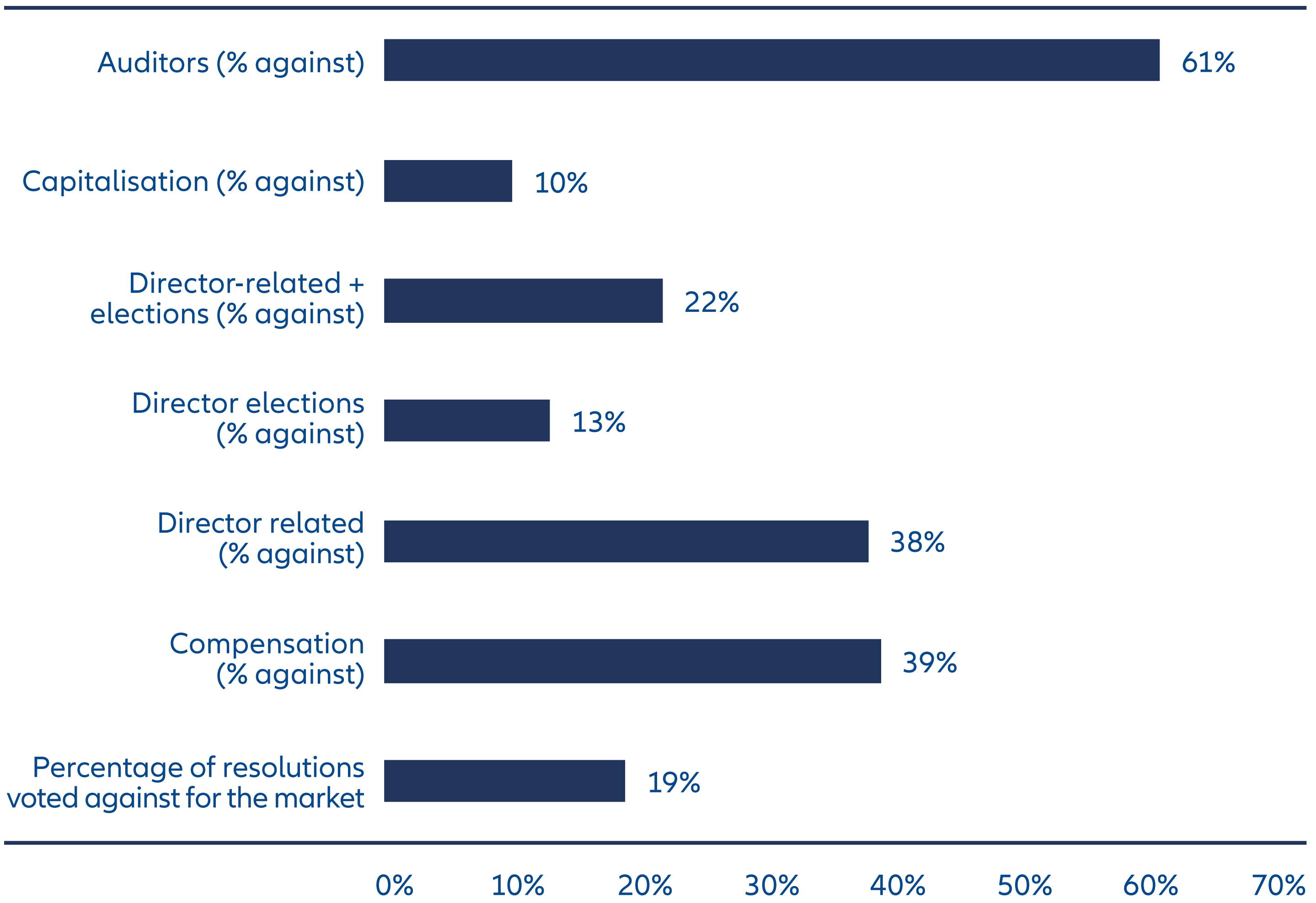
We voted in 100% of the 1,320 meetings in the Chinese market, where we are qualified to vote as a minority shareholder. The total number of proposals totalled over 10,500. We voted against management or abstained in 19% of these meetings, demonstrating how we use proxy voting to take a stance on important issues as part of our fiduciary duties. Most votes “against” related to electing auditors, director-related proposals, and incentive plans. The complete records of voting results and rationales are publicly disclosed on our website. Notably, our comments left through custodian systems are conveyed to the listed companies and we proactively announce our voting rationales to these entities.

Exhibit 4: AllianzGI votes against management by proposal category

Source: Allianz Global Investors, proxy voting in China, as at 31 December 2023

We align our engagement approach and priorities with proxy voting decisions. This ensures an effective stewardship approach and provides a basis for potential escalation actions, such as collaborative engagements, pre-announcing votes, and votes against relevant board appointments.

CASE STUDY
Engaging with a SOE on related party transactions with its group finance company

In China, it is common for central state-owned enterprises to establish a group finance company (GFC) subsidiary to facilitate deposits and loans between affiliated companies. While in theory this can promote capital efficiency and save commission costs, it can harm listed companies by offering lower interest rates on their deposits and compromising their capital liquidity. After learning that such a proposal was being voted on at an upcoming AGM we initiated a pre-AGM engagement with the company to ensure the return of deposits, evaluate the GFC’s risk management system’s robustness, and examine the policies and disclosure of deposit usage.

After an in-depth evaluation and meeting, we concluded that returns on deposits were above market levels and the transactions could mutually benefit the SOE and its parent group subsidiaries if managed effectively. Furthermore, the tracking record with the GFC was satisfactory. Therefore, we decided to support the resolution and will continue to monitor the company’s transactions with the GFC throughout the financial year to ensure that the commitments align with progress. The findings from our review will inform our future proxy voting decisions.

Future expectations

Notwithstanding the unique characteristics of the Chinese market, we believe effective investor stewardship is possible. The key is to follow a customised and active approach that drives improved risk materiality and sustainable outcomes. This includes the careful scoping, preparation and conducting of engagements aligned to proxy voting, and a commitment to building trust and sharing insights.

Can shareholder activism make a difference in China? Looking back at 2023, we voted on 10,515 proposals, most of which were tabled by management. Fewer than 5% came from shareholders and mostly controlling shareholders, predominantly focusing on the election or removal of board directors. This highlights the need for more institutional investors to take an active approach in the stewardship of their assets. Furthermore, there are no examples of shareholder proposals on environmental or social topics. This could be attributed to the historically high regulatory threshold set, which allows only shareholders individually or collectively holding more than 3% of common shares to raise proposals, subject to approval by boards of directors. In the latest revised Company Law to come into effect in July 2024, the threshold is reduced to 1%. Collaboration among institutional investors could lead to more opportunities to push for shareholder activism - particularly for environmental and social themes.

We believe the power of policy-level clarity on stewardship activities and incentives passing from domestic asset owners to institutional investors could be the ultimate catalyst for collaborative stewardship efforts in the Chinese market.

Key sustainability goals on the agenda for China are decarbonisation, biodiversity, and social resilience, which are needed to support long-term economic growth, development and stability. Investor stewardship with even more ambitious goals and robust implementation can help expedite this trajectory. With a clear and strategic focus on the Chinese market, we will continue to embrace shareholder activism in further strengthening our approach to stewardship in China.

1 Asset Management Association of China, 2012
2 Insurance Asset Management Association of China, 2022
3 UN Principles for Responsible Ownership, 2016
4 David Atkin, CEO of the PRI, reflects on a recent visit to China – one of our fastest-growing markets in recent years | PRI (unpri.org)
5 The China A-shares market accounting for 85% of the total market capitalisation of China’s listed businesses is defined as the fair universe for analysis in this article
6 Wind data, compiled by Allianz Global Investors Date, 31 December 2023
7 General individual investors are defined as individual shareholders who are not top 10 significant shareholders of the floating shares
8 Money and Banking Statistics, PBOC, compiled by AllianzGI

Investing involves risk. The value of an investment and the income from it will fluctuate and investors may not get back the principal invested. Past performance is not indicative of future performance. This is a marketing communication. It is for informational purposes only. This document does not constitute investment advice or a recommendation to buy, sell or hold any security and shall not be deemed an offer to sell or a solicitation of an offer to buy any security.

The views and opinions expressed herein, which are subject to change without notice, are those of the issuer or its affiliated companies at the time of publication. Certain data used are derived from various sources believed to be reliable, but the accuracy or completeness of the data is not guaranteed and no liability is assumed for any direct or consequential losses arising from their use. The duplication, publication, extraction or transmission of the contents, irrespective of the form, is not permitted.This material has not been reviewed by any regulatory authorities. In mainland China, it is for Qualified Domestic Institutional Investors scheme pursuant to applicable rules and regulations and is for information purpose only. This document does not constitute a public offer by virtue of Act Number 26.831 of the Argentine Republic and General Resolution No. 622/2013 of the NSC. This communication’s sole purpose is to inform and does not under any circumstance constitute promotion or publicity of Allianz Global Investors products and/or services in Colombia or to Colombian residents pursuant to part 4 of Decree 2555 of 2010. This communication does not in any way aim to directly or indirectly initiate the purchase of a product or the provision of a service offered by Allianz Global Investors. Via reception of his document, each resident in Colombia acknowledges and accepts to have contacted Allianz Global Investors via their own initiative and that the communication under no circumstances does not arise from any promotional or marketing activities carried out by Allianz Global Investors. Colombian residents accept that accessing any type of social network page of Allianz Global Investors is done under their own responsibility and initiative and are aware that they may access specific information on the products and services of Allianz Global Investors. This communication is strictly private and confidential and may not be reproduced, except for the case of explicit permission by Allianz Global Investors. This communication does not constitute a public offer of securities in Colombia pursuant to the public offer regulation set forth in Decree 2555 of 2010. This communication and the information provided herein should not be considered a solicitation or an offer by Allianz Global Investors or its affiliates to provide any financial products in Brazil, Panama, Peru, and Uruguay. In Australia, this material is presented by Allianz Global Investors Asia Pacific Limited (“AllianzGI AP”) and is intended for the use of investment consultants and other institutional /professional investors only, and is not directed to the public or individual retail investors. AllianzGI AP is not licensed to provide financial services to retail clients in Australia. AllianzGI AP is exempt from the requirement to hold an Australian Foreign Financial Service License under the Corporations Act 2001 (Cth) pursuant to ASIC Class Order (CO 03/1103) with respect to the provision of financial services to wholesale clients only. AllianzGI AP is licensed and regulated by Hong Kong Securities and Futures Commission under Hong Kong laws, which differ from Australian laws.This document is being distributed by the following Allianz Global Investors companies: Allianz Global Investors GmbH, an investment company in Germany, authorized by the German Bundesanstalt für Finanzdienstleistungsaufsicht (BaFin); Allianz Global Investors (Schweiz) AG; Allianz Global Investors UK Limited, authorized and regulated by the Financial Conduct Authority; in HK, by Allianz Global Investors Asia Pacific Ltd., licensed by the Hong Kong Securities and Futures Commission; in Singapore, by Allianz Global Investors Singapore Ltd., regulated by the Monetary Authority of Singapore [Company Registration No. 199907169Z]; in Japan, by Allianz Global Investors Japan Co., Ltd., registered in Japan as a Financial Instruments Business Operator [Registered No. The Director of Kanto Local Finance Bureau (Financial Instruments Business Operator), No. 424], Member of Japan Investment Advisers Association, the Investment Trust Association, Japan and Type II Financial Instruments Firms Association; in Taiwan, by Allianz Global Investors Taiwan Ltd., licensed by Financial Supervisory Commission in Taiwan; and in Indonesia, by PT. Allianz Global Investors Asset Management Indonesia licensed by Indonesia Financial Services Authority (OJK).

3460183

Recent insights

Insight

Structural processes can help counter behavioural biases and turn discipline into an investment edge.

Discover more

Embracing Disruption

China's electrification strategy drives renewable energy adoption, grid modernization, and industrial growth in EVs, AI, and advanced manufacturing sectors.

Discover more

Geopolitical shocks rarely disrupt markets for long – unless they spill into the real economy.

Discover more

Allianz Global Investors

You are leaving this website and being re-directed to the below website. This does not imply any approval or endorsement of the information by Allianz Global Investors Asia Pacific Limited contained in the redirected website nor does Allianz Global Investors Asia Pacific Limited accept any responsibility or liability in connection with this hyperlink and the information contained herein. Please keep in mind that the redirected website may contain funds and strategies not authorized for offering to the public in your jurisdiction. Besides, please also take note on the redirected website’s terms and conditions, privacy and security policies, or other legal information. By clicking “Continue”, you confirm you acknowledge the details mentioned above and would like to continue accessing the redirected website. Please click “Stay here” if you have any concerns.

Welcome to Allianz Global Investors

Select your language
  • 中文(繁體)
  • English
Select Role
  • Individual Investor
  • Intermediaries
  • Other Investors
  • Pension Investors
  • Allianz Global Investors Fund (“AGIF”)

     • Allianz Global Investors Fund (“AGIF”) as an umbrella fund under the UCITS regulations has within it different Sub-Funds investing in fixed income securities, equities, and derivative instruments, each with a different investment objective and/or risk profile.

    All Sub-Funds may invest in financial derivative instruments (“FDI”) which may expose to higher leverage, counterparty, liquidity, valuation, volatility, market and over the counter transaction risks. A Sub-Fund’s net derivative exposure may be up to 50% of its net asset value (“NAV”). 

    Some Sub-Funds as part of their investments may invest in any one or a combination of the instruments such as fixed income securities, emerging market securities, and/or mortgage-backed securities, asset-backed securities, property-backed securities (especially REITs) and/or structured products and/or FDI, exposing to various potential risks (including leverage, counterparty, liquidity, valuation, volatility, market, fluctuations in the value of and the rental income received in respect of the underlying property, and over the counter transaction risks). 

    Some Sub-Funds may invest in single countries or industry sectors (in particular small/mid cap companies) which may reduce risk diversification. Some Sub-Funds are exposed to significant risks which include investment/general market, country and region, emerging market (such as Mainland China), creditworthiness/credit rating/downgrading, default, asset allocation, interest rate, volatility and liquidity, counterparty, sovereign debt, valuation, credit rating agency, company-specific, currency (in particular RMB), RMB debt securities and Mainland China tax risks. 

    Some Sub-Funds may invest in convertible bonds, high-yield, non-investment grade investments and unrated securities that may be subject to higher risks (including volatility, loss of principal and interest, creditworthiness and downgrading, default, interest rate, general market and liquidity risks) and therefore may adversely impact the net asset value of the Sub-Funds. Convertibles will be exposed prepayment risk, equity movement and greater volatility than straight bond investments.

    Some Sub-Funds may invest a significant portion of the assets in interest-bearing securities issued or guaranteed by a non-investment grade sovereign issuer (e.g. Philippines) and is subject to higher risks of liquidity, credit, concentration and default of the sovereign issuer as well as greater volatility and higher risk profile that may result in significant losses to the investors. 

    Some Sub-Funds may invest in European countries. The economic and financial difficulties in Europe may get worse and adversely affect the Sub-Funds (such as increased volatility, liquidity and currency risks associated with investments in Europe).

    Some Sub-Funds may invest in the China A-Shares market, China B-Shares market and/or debt securities directly via the Stock Connect or the China Interbank Bond Market or Bond Connect or other foreign access regimes and/or other permitted means and/or indirectly through all eligible instruments and thus is subject to the associated risks (including quota limitations, change in rule and regulations, repatriation of the Sub-Fund’s monies, trade restrictions, clearing and settlement, China market volatility and uncertainty, China market volatility and uncertainty, potential clearing and/or settlement difficulties, change in economic, social and political policy in the PRC and Mainland China tax risks).  

    Some Sub-Funds may adopt the following strategies, Socially Responsible Investment (Proprietary Scoring) Strategy, SDG-Aligned Strategy, Sustainability Key Performance Indicator Strategy (Relative), Green Bond Strategy, Multi Asset Sustainable Strategy, Sustainability Key Performance Indicator Strategy (Absolute Threshold), Environment, Social and Governance (“ESG”) Score Strategy, and Sustainability Key Performance Indicator Strategy (Absolute). The Sub-Funds may be exposed to sustainable investment risks relating to the strategies (such as foregoing opportunities to buy certain securities when it might otherwise be advantageous to do so, selling securities when it might be disadvantageous to do so, and/or relying on information and data from third party ESG research data providers and internal analyses which may be subjective, incomplete, inaccurate or unavailable and/or reducing risk diversifications compared to broadly based funds). Also, some Sub-Funds may be particularly focusing on the greenhouse gas emissions (“GHG”) efficiency of the investee companies rather than their financial performance. These may have an adverse impact on the performance of the Sub-Funds.

    Some Sub-Funds may invest in share class with fixed distribution percentage (Class AMf). Investors should note that fixed distribution percentage is not guaranteed. The share class is not an alternative to fixed interest paying investment. The percentage of distributions paid by these share classes is unrelated to expected or past income or returns of these share classes or the Sub-Funds. Distribution will continue even the Sub-Fund has negative returns and may adversely impact the net asset value of the Sub-Fund.  Positive distribution yield does not imply positive return.

    Investment involves risks that could result in loss of part or entire amount of investors’ investment.

    In making investment decisions, investors should not rely solely on this [website/material].


    Note: Dividend payments may, at the sole discretion of the Investment Manager, be made out of the Sub-Fund’s capital or effectively out of the Sub-Fund’s capital which represents a return or withdrawal of part of the amount investors originally invested and/or capital gains attributable to the original investment. This may result in an immediate decrease in the NAV per share and the capital of the Sub-Fund available for investment in the future and capital growth may be reduced, in particular for hedged share classes for which the distribution amount and NAV of any hedged share classes (HSC) may be adversely affected by differences in the interests rates of the reference currency of the HSC and the base currency of the respective Sub-Fund, particularly if such HSC are applying the IRD Neutral Policy. Dividend payments are applicable for Class A/AM/AMg/AMi/AMgi/AQ Dis (Annually/Monthly/Quarterly distribution) and for reference only but not guaranteed.  Positive distribution yield does not imply positive return. For details, please refer to the Sub-Fund’s distribution policy disclosed in the offering documents.


    Allianz Global Investors Asia Fund

    Allianz Global Investors Asia Fund (the “Trust”) is an umbrella unit trust constituted under the laws of Hong Kong pursuant to the Trust Deed. Allianz Thematic Income and Allianz Selection Income and Growth and Allianz Yield Plus Fund are the sub-funds of the Trust (each a “Sub-Fund”) investing in fixed income securities, equities and derivative instruments, each with a different investment objective and/or risk profile.

    Some Sub-Funds are exposed to significant risks which include investment/general market, company-specific, emerging market, creditworthiness/credit rating/downgrading, default, volatility and liquidity, valuation, sovereign debt, thematic concentration, thematic-based investment strategy, counterparty, interest rate changes, country and region, asset allocation risks and currency (such as exchange controls, in particular RMB), and the adverse impact on RMB share classes due to currency depreciation.  

    A Sub-Fund may invest in asset-backed securities (“ABS”) and mortgage-backed securities (“MBS”) which may be highly illiquid and prone to substantial price volatility. These instruments may be subject to greater general market risk, concentration risk, credit and counterparty default risk, liquidity risk and interest rate risk compared to other debt securities.

    Some Sub-Funds may invest in high-yield (non-investment grade and unrated) investments and convertible bonds which may be subject to higher risks, such as volatility, creditworthiness, default, interest rate changes, general market and liquidity risks and therefore may  adversely impact the net asset value of the Sub-Fund. 

    All Sub-Funds may invest in financial derivative instruments (“FDI”) which may expose to higher leverage, counterparty, liquidity, valuation, volatility, market and over the counter transaction risks.  The use of derivatives may result in losses to the Sub-Funds which are greater than the amount originally invested. A Sub-Fund’s net derivative exposure may be up to 50% of its net asset value (“NAV”).

    These investments may involve risks that could result in loss of part or entire amount of investors’ investment.

    In making investment decisions, investors should not rely solely on this website.

    Note: Dividend payments may, at the sole discretion of the Investment Manager, be made out of the Sub-Fund’s income and/or capital which in the latter case represents a return or withdrawal of part of the amount investors originally invested and/or capital gains attributable to the original investment. This may result in an immediate decrease in the NAV per distribution unit and the capital of the Sub-Fund available for investment in the future and capital growth may be reduced, in particular for hedged share classes for which the distribution amount and NAV of any hedged share classes (HSC) may be adversely affected by differences in the interests rates of the reference currency of the HSC and the base currency of the Sub-Fund, particularly if such HSC are applying the IRD Neutral Policy. Dividend payments are applicable for Class A/AM/AMg/AMi/AMgi Dis (Annually/Monthly distribution) and for reference only but not guaranteed.  Positive distribution yield does not imply positive return. For details, please refer to the Sub-Fund’s distribution policy disclosed in the offering documents.

Please indicate you have read and understood the Important Notice.