
Embracing Disruption
Global tech: 5 themes for 2026


2025 may well be looked back upon as a historic inflection point for tech, and artificial intelligence (AI) in particular, with breakthroughs in model capabilities, surging adoption, and unprecedented capital investment. AI has become the key catalyst reshaping tech and even broader equity markets. Meanwhile, many of the trends we looked forward to in early 2025 – including the growth of high-speed networking, parallel opportunities in application specific chips alongside GPUs, and a growing focus on data hygiene – continue to shape markets.
Yet as demand for computing resources and power surge in parallel, the stage is set for a new wave of structural trends that will shape markets beyond the traditional cyclical patterns. 2026 is thus poised to be consequential, with several themes rising to the forefront. In this respect, we see the most consequential as the continuation of the memory supercycle, the escalation of semiconductor capex into a full supercycle, intensifying data-center power requirements, the emergence of enterprise AI adoption, and the rebound of analog semiconductors.
Together, these dynamics illustrate how AI is no longer just a tech trend, but the force currently driving the reorganization of the entire semiconductor and tech ecosystems – and the landscape for tech investors.
Cycles and supercycles
The semiconductor sector enters 2026 amid overlapping supercycles, each driven by the unprecedented growth of AI. At the heart of this shift is the memory supercycle, where the bottleneck has moved from computing speed to memory bandwidth. High‑Bandwidth Memory (HBM) has emerged as a critical constraint, with capacity effectively sold out through 2026 as AI workloads strain the limits of data movement rather than arithmetic performance. As a result, many analysts now expect a two‑tier memory economy, with AI infrastructure booming as PCs and smartphones face supply pressure, possibly lengthening the duration of the current cycle.Memory capacity comparison: consumer devices vs NVIDIA AI GPUs
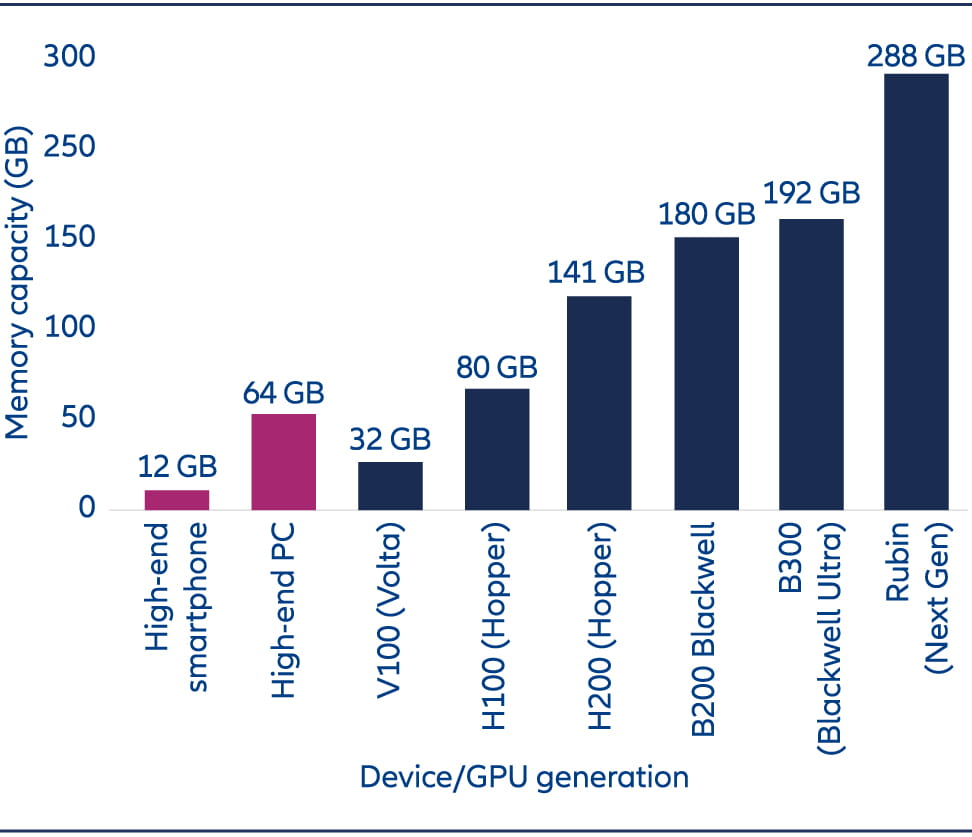
Source: Bloomberg, February 2026 Memory capacity (GB)
Running in parallel is the semiconductor capex supercycle, fueled by the same surge in AI demand, alongside geopolitical changes and related efforts to regionalize production. China is pursuing self‑sufficiency by scaling domestic foundry capacity, while the CHIPS Act in the US continues to offer incentives to reshape global production. The broader capex environment will thus remain elevated as manufacturers race to satisfy AI‑driven demand.
Scaling amid power constraints
By 2030, global data center electricity consumption is expected to more than double, with AI‑optimized facilities quadrupling power use; several regions are already facing grid stress and substation limitations. In the US, for example, data centers could consume nearly 9% of national electricity by 2030, driven largely by AI acceleration. As a result, the industry is shifting toward on‑site power generation, with forecasts suggesting that by 2030, about 30% of data centers will rely partially on behind‑the‑meter sources – for instance, natural gas, batteries, solar, and even small nuclear reactors.In 2026, the hyperscalers are expected to build newer AI‑first facilities, as retrofitting older buildings becomes increasingly insufficient for GPU‑intensive workloads. Power constraints will remain the limiting factor for capacity expansion, influencing site selection, permitting, and the economics of the AI infrastructure rollout.
Mainstreaming enterprise AI
2026 will be marked by enterprise AI moving from experimentation to full‑scale deployment. With worker access to AI up 50%, many organizations are finally operationalizing the groundwork laid over recent years. Indeed, most firms are now moving beyond pilots and embedding AI directly into workflows, decision‑making, and industry‑specific applications.While challenges remain – data quality is still uneven, and talent gaps persist in some sectors, for example – companies are currently focusing on AI fluency and governance, while also adapting models to local regulatory and infrastructure contexts; we thus expect to see corporates scaling generative in 2026. Budgets are rising, and the winners will be those who successfully align data governance, workflow redesign, and talent upskilling to fully harness AI’s potential.
Analog semis – recovery and acceleration
After a downturn in automotive and consumer markets in 2024, analog semiconductors began to rebound in 2025. As AI‑driven demand lifts the broader semiconductor landscape, analogs – vital for functions such as power management, sensing, signal conditioning, and vehicle electronics – are regaining momentum. The market is expected to grow from about $99 billion in 2026 toward $154 billion by 2034, supported by EV adoption, industrial automation, and next‑generation consumer devices.Meanwhile, the rise of energy‑hungry AI data centers is also boosting demand for high‑efficiency analog power components. Asia‑Pacific remains the largest market here, with North America forecast to grow fastest through the early 2030s. AI is thus also further reshaping analog workflows and enhancing innovation across this segment.
Conclusion
The shifts underway across the semiconductor and AI ecosystems point to a market environment defined less by linear growth and more by overlapping supercycles, structural bottlenecks, and rapidly evolving corporate adoption patterns. For investors, we believe these dynamics are creating opportunities, as certain sectors will continue to enjoy outsized growth in 2026 and beyond.However, these trends are far from uniform, and an active approach is essential to successfully navigate volatility, valuation extremes, and shifting fundamentals. The coming year will reward investors who can distinguish enduring structural drivers from short‑term narrative momentum, positioning portfolios to participate in the next phase of AI‑driven transformation.
The 5 tech themes for 2026 have been compiled by the Global Tech Equity Ecosystem at Allianz Global Investors.