

Navigating Rates
Understanding US convertibles and why they’re attractive today



Over the last 35-plus years, US convertibles have produced equity-like performance but with lower volatility. Today, accelerating new issuance and expanding market breadth add to the appeal of this distinctive asset class.
Key takeaways
- Convertible securities have offered equity-like return potential with reduced volatility, allowing for gains during market ups and benefiting from protection when markets decline.
- New issuance expands the opportunity set of total return convertibles, which offer a compelling asymmetric risk/reward profile.
- We believe active management is key to unlocking opportunities and managing risks in the evolving market environment.
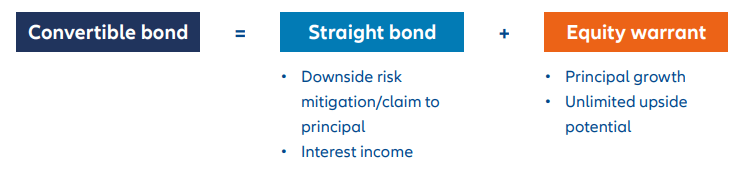
A convertible security is a traditional bond that can be converted or exchanged into a specific number of shares of the issuer’s common stock. Convertibles have characteristics of both bonds and stocks, which can help improve a portfolio’s overall risk-adjusted returns (see Exhibit 1).
The bond component provides income potential and reduced volatility, derived from the stated coupon and maturity and the claim to principal. Like other bonds, a convertible’s value can fluctuate with changes in interest rates and the credit quality of the issuing company. Convertible securities generally have a lower coupon than corporate bonds, but they usually offer a yield advantage over the common stock dividend.
The equity component provides unlimited capital appreciation potential, derived from an option (determined at issuance) that provides the right to convert into a fixed number of common shares. Because of this feature, when convertible securities mature, they can be redeemed at the market value of the underlying common shares or at their face value – whichever is higher.
Exhibit 1: A simplified structure showing the basic components of convertibles
Source: Voya IM. For illustrative purposes only.
How do convertible securities behave?
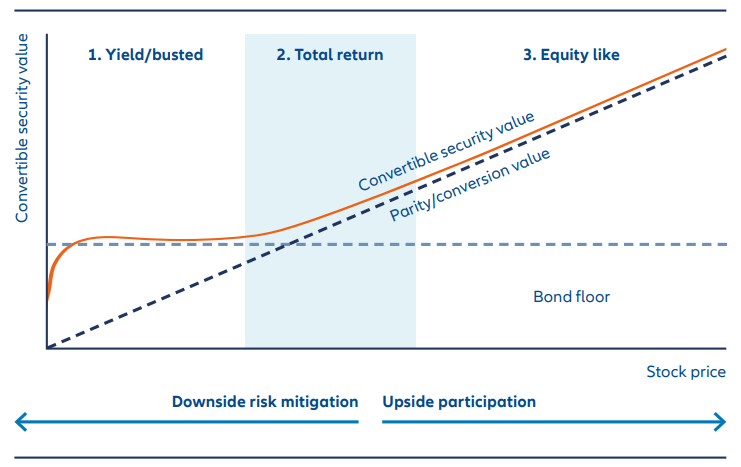
The behaviour of a convertible security may take on either stock-like or bond-like characteristics, depending upon where the underlying stock is trading in relation to the bond’s conversion price. The security tends to become more equity-like as the price of the common shares rises (see Exhibit 2), which means its participation in the stock’s upside may increase. As the underlying stock price falls, the convertible may act more bond-like, which means its participation in the stock’s downside tends to decrease. It is important to note that convertibles are subject to the same risk factors as stocks and bonds, including market, interest rate and credit risks.
Exhibit 2: Three types of convertibles
Source: Voya IM. For illustrative purposes only.
1. Yield/busted
Convertibles in this category are characterised by high yields and high conversion premiums. Given that the equity option is out of the money, these securities behave more like corporate bonds, with little regard given to the option value.
- Behave more like fixed income instruments
- Low correlation to the underlying equity
- Delta below 0.41
2. Total return
Convertibles in this category exhibit ideal qualities, characterised by moderate conversion premiums and some equity sensitivity.
- Provide an asymmetric risk/reward profile
- Capture more of the upside and less of the downside of the underlying equity
- Delta between 0.4 and 0.81
3. Equity like
Convertibles in this category behave like equity investments, characterised by lower conversion premiums and a high degree of equity sensitivity.
- Behave more like equity instruments
- High correlation to the underlying equity
- Delta greater than 0.81
Why consider investing in convertible securities?
Asymmetric risk/reward
Convertible securities offer an asymmetric risk/reward profile in which the upside opportunity (reward) can exceed the downside capture (risk). Over the last 35 years, which have included multiple periods of elevated volatility, US convertibles have produced equity-like performance but with lower volatility (see Exhibits 3 and 4).
Exhibit 3: US convertibles have captured more of the stock market’s upside than downside

As of 31/12/25. Source: FactSet, ICE Data Services, Voya IM, Morningstar. Past performance is not indicative of future results. This statement reflects performance and characteristics for the time period shown; results over a different time period may have been more or less favourable. US convertibles: ICE BofA US Convertibles Index. US stocks: S&P 500 Index.
Exhibit 4: US convertibles have delivered equity-like returns with lower volatility

As of 31/12/25. Source: FactSet, ICE Data Services, Voya IM, Morningstar. Past performance is not indicative of future results. This statement reflects performance and characteristics for the time period shown; results over a different time period may have been more or less favourable. US convertibles: ICE BofA US Convertibles Index. US stocks: S&P 500 Index.
Improving new issuance
US convertible new issuance set a record in 2025 (Exhibit 5). Momentum has continued with primary market activity getting off to a very strong start in 2026. Market strategists estimate this year’s new issuance volume will be elevated due to coupon savings demand and a steady refinancing pipeline paired with strong investor appetite for longerterm upside optionality. Artificial intelligence-linked spending, M&A activity and selective investment grade and hybrid issuance should also support deal flow throughout the year.
Although the US Federal Reserve has cut interest rates, the yields of longer maturity US Treasuries – the foundation of corporate borrowing costs – have remained relatively elevated. As a result, companies have found convertible securities desirable because they offer lower interest expense costs for corporations compared with straight debt.
New issuance is key because it helps balance and diversify the overall market and expands the investment opportunity set of “total return” or “balanced” convertibles, which are often the most favoured by investors.
Exhibit 5: Record new issuance

As of 31/12/25. Source: Voya IM (using data from ICE Data Indices, LLC). Projections are based on assumptions with respect to future events. The actual future events may differ from the assumptions. Past performance is not indicative of future results. This statement reflects performance and characteristics for the time period shown; results over a different time period may have been more or less favourable.
Terms to know
- Conversion ratio
The number of common shares into which a convertible bond can be exchanged. - Conversion price
Equal to the face value of the bond divided by the conversion ratio. - Conversion premium
The price an investor must pay above the conversion value (number of shares represented in the conversion ratio, multi-plied by the common share price). Typically, the higher the conversion premium, the less equity sensitive the convertible security is; the lower the conversion premium, the more equity sensitive. - Delta
A measure of the convertible security’s price sensitivity to underlying stock price movements. The lower the delta, the less equity sensitive the convertible security is; the higher the delta, the more equity sensitive.
A broadening out of the market
Over the last five years, the convertible market’s upside capture rate has underwhelmed versus the broad equity market, whose gains were largely driven by mega-cap companies. Additionally, the convertible market’s lower delta entering 2023 limited upside capture.
More recently, these headwinds have eased, and convertible securities have delivered strong performance. The asset class outpaced the S&P 500 Index in 2025, and US convertibles have produced a high single digit return year-to-date.
While a change in market leadership is not a certainty, a sustained broadening of the equity market should be a positive development for convertible investors.
Given the asset class’s skew away from mega-cap companies, convertibles could be well positioned to benefit from greater market breadth.
Active managers can take advantage of market opportunities
Passive investment strategies may not find it easy adjust to changes in the convertible market’s composition, issuer fundamentals or individual issue characteristics, among other factors. In addition, these strategies may not have discretion related to new issuance. We therefore believe that active management is critical to minimising portfolio risks – such as fundamental/credit and concentration risks – while adjusting to changing risk/reward profiles (ie, delta, conversion premiums, etc.) of individual issues, which are driven by the movement of the underlying equity.
A note about risk
All investing involves risks of fluctuating prices and the uncertainties of rates of return and yield inherent in investing. All security transactions involve substantial risk of loss.
Debt instruments: Debt instruments are subject to greater levels of credit and liquidity risk, may be speculative, and may decline in value due to changes in interest rates or an issuer’s or counterparty’s deterioration or default.
Market volatility: The value of the securities in the portfolio may go up or down in response to the prospects of individual companies and/or general economic conditions. Price changes may be short or long term. Local, regional or global events such as war, acts of terrorism, the spread of infectious illness or other public health issue, recessions, or other events could have a significant impact on the portfolio and its investments, including hampering the ability of the portfolio’s manager(s) to invest the portfolio’s assets as intended.
Issuer risk: The portfolio will be affected by factors specific to the issuers of securities and other instruments in which the portfolio invests, including actual or perceived changes in the financial condition or business prospects of such issuers.
Interest rate risk: The values of debt instruments may rise or fall in response to changes in interest rates, and this risk may be enhanced for securities with longer maturities.
Credit risk: If the issuer of a debt instrument fails to pay interest or principal in a timely manner, or negative perceptions exist in the market of the issuer’s ability to make such payments, the price of the security may decline.
1 BofA Global Research, as of March 2026. Deltas below 0.1 indicate distressed debt.