

Embracing Disruption

Global tech: 5 themes for 2026

2025 may well be looked back upon as a historic inflection point for tech, and artificial intelligence (AI) in particular, with breakthroughs in model capabilities, surging adoption, and unprecedented capital investment. AI has become the key catalyst reshaping tech and even broader equity markets. Meanwhile, many of the trends we looked forward to in early 2025 – including the growth of high-speed networking, parallel opportunities in application specific chips alongside GPUs, and a growing focus on data hygiene – continue to shape markets.

Yet as demand for computing resources and power surge in parallel, the stage is set for a new wave of structural trends that will shape markets beyond the traditional cyclical patterns. 2026 is thus poised to be consequential, with several themes rising to the forefront. In this respect, we see the most consequential as the continuation of the memory supercycle, the escalation of semiconductor capex into a full supercycle, intensifying data-center power requirements, the emergence of enterprise AI adoption, and the rebound of analog semiconductors.

Together, these dynamics illustrate how AI is no longer just a tech trend, but the force currently driving the reorganization of the entire semiconductor and tech ecosystems – and the landscape for tech investors.

Cycles and supercycles
The semiconductor sector enters 2026 amid overlapping supercycles, each driven by the unprecedented growth of AI. At the heart of this shift is the memory supercycle, where the bottleneck has moved from computing speed to memory bandwidth. High‑Bandwidth Memory (HBM) has emerged as a critical constraint, with capacity effectively sold out through 2026 as AI workloads strain the limits of data movement rather than arithmetic performance. As a result, many analysts now expect a two‑tier memory economy, with AI infrastructure booming as PCs and smartphones face supply pressure, possibly lengthening the duration of the current cycle.

Memory capacity comparison: consumer devices vs NVIDIA AI GPUs
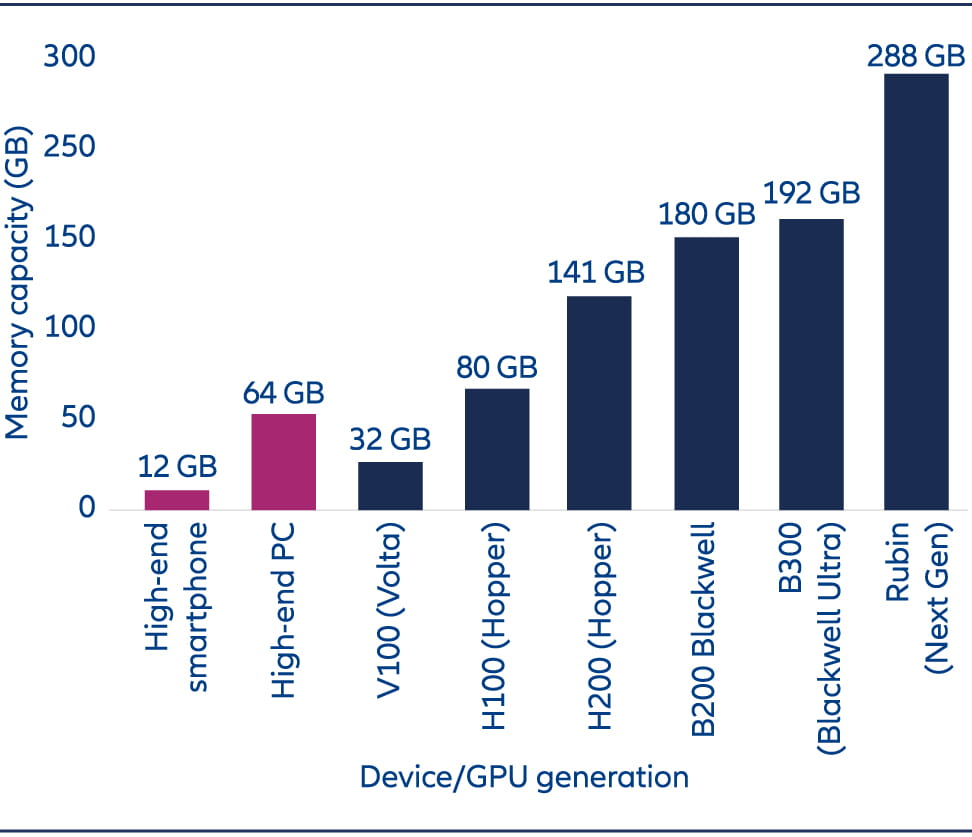
Source: Bloomberg, February 2026 Memory capacity (GB)


Running in parallel is the semiconductor capex supercycle, fueled by the same surge in AI demand, alongside geopolitical changes and related efforts to regionalize production. China is pursuing self‑sufficiency by scaling domestic foundry capacity, while the CHIPS Act in the US continues to offer incentives to reshape global production. The broader capex environment will thus remain elevated as manufacturers race to satisfy AI‑driven demand.

Scaling amid power constraints
By 2030, global data center electricity consumption is expected to more than double, with AI‑optimized facilities quadrupling power use; several regions are already facing grid stress and substation limitations. In the US, for example, data centers could consume nearly 9% of national electricity by 2030, driven largely by AI acceleration. As a result, the industry is shifting toward on‑site power generation, with forecasts suggesting that by 2030, about 30% of data centers will rely partially on behind‑the‑meter sources – for instance, natural gas, batteries, solar, and even small nuclear reactors.

In 2026, the hyperscalers are expected to build newer AI‑first facilities, as retrofitting older buildings becomes increasingly insufficient for GPU‑intensive workloads. Power constraints will remain the limiting factor for capacity expansion, influencing site selection, permitting, and the economics of the AI infrastructure rollout.

Mainstreaming enterprise AI
2026 will be marked by enterprise AI moving from experimentation to full‑scale deployment. With worker access to AI up 50%, many organizations are finally operationalizing the groundwork laid over recent years. Indeed, most firms are now moving beyond pilots and embedding AI directly into workflows, decision‑making, and industry‑specific applications.

While challenges remain – data quality is still uneven, and talent gaps persist in some sectors, for example – companies are currently focusing on AI fluency and governance, while also adapting models to local regulatory and infrastructure contexts; we thus expect to see corporates scaling generative in 2026. Budgets are rising, and the winners will be those who successfully align data governance, workflow redesign, and talent upskilling to fully harness AI’s potential.

Analog semis – recovery and acceleration
After a downturn in automotive and consumer markets in 2024, analog semiconductors began to rebound in 2025. As AI‑driven demand lifts the broader semiconductor landscape, analogs – vital for functions such as power management, sensing, signal conditioning, and vehicle electronics – are regaining momentum. The market is expected to grow from about $99 billion in 2026 toward $154 billion by 2034, supported by EV adoption, industrial automation, and next‑generation consumer devices.

Meanwhile, the rise of energy‑hungry AI data centers is also boosting demand for high‑efficiency analog power components. Asia‑Pacific remains the largest market here, with North America forecast to grow fastest through the early 2030s. AI is thus also further reshaping analog workflows and enhancing innovation across this segment.

Conclusion
The shifts underway across the semiconductor and AI ecosystems point to a market environment defined less by linear growth and more by overlapping supercycles, structural bottlenecks, and rapidly evolving corporate adoption patterns. For investors, we believe these dynamics are creating opportunities, as certain sectors will continue to enjoy outsized growth in 2026 and beyond.

However, these trends are far from uniform, and an active approach is essential to successfully navigate volatility, valuation extremes, and shifting fundamentals. The coming year will reward investors who can distinguish enduring structural drivers from short‑term narrative momentum, positioning portfolios to participate in the next phase of AI‑driven transformation.

The 5 tech themes for 2026 have been compiled by the Global Tech Equity Ecosystem at Allianz Global Investors.


Investing involves risk. The value of an investment and the income from it may fall as well as rise and investors might not get back the full amount invested.

Past performance does not predict future returns. If the currency in which the past performance is displayed differs from the currency of the country in which the investor resides, then the investor should be aware that due to the exchange rate fluctuations the performance shown may be higher or lower if converted into the investor’s local currency.

This is for information only and not to be construed as a solicitation or an invitation to make an offer to buy or sell any securities. The views and opinions expressed herein, which are subject to change without notice, are those of the issuer or its affiliated companies at the time of publication. The data used is derived from various sources and assumed to be accurate and reliable at the time of publication. but it has not been independently verified; its accuracy or completeness is not guaranteed and no liability is assumed for any direct or consequential losses arising from its use, unless caused by gross negligence or willful misconduct. The duplication, publication, extraction or transmission of the contents, irrespective of the form, is not permitted, except for the case of explicit permission by Allianz Global Investors. This material has not been reviewed by any regulatory authorities.

This document is being distributed by the following Allianz Global Investors companies: In Australia, this material is presented by Allianz Global Investors Asia Pacific Limited (“AllianzGI AP”) and is intended for the use of investment consultants and other institutional/professional investors only, and is not directed to the public or individual retail investors. AllianzGI AP is not licensed to provide financial services to retail clients in Australia. AllianzGI AP is exempt from the requirement to hold an Australian Foreign Financial Service License under the Corporations Act 2001 (Cth) pursuant to ASIC Class Order (CO 03/1103) with respect to the provision of financial services to wholesale clients only. AllianzGI AP is licensed and regulated by Hong Kong Securities and Futures Commission under Hong Kong laws, which differ from Australian laws; in the European Union, by Allianz Global Investors GmbH, an investment company in Germany, authorized by the German Bundesanstalt für Finanzdienstleistungs-aufsicht (BaFin) and is authorized and regulated in South Africa by the Financial Sector Conduct Authority; in the UK, by Allianz Global Investors (UK) Ltd. company number 11516839, authorised and regulated by the Financial Conduct Authority (FCA); in Switzerland, by Allianz Global Investors (Schweiz) AG, authorised by the Swiss financial markets regulator (FINMA); in HK, by Allianz Global Investors Asia Pacific Ltd., licensed by the Hong Kong Securities and Futures Commission; in Singapore, by Allianz Global Investors Singapore Ltd., regulated by the Monetary Authority of Singapore [Company Registration No. 199907169Z]; in Japan, by Allianz Global Investors Japan Co., Ltd., registered in Japan as a Financial Instruments Business Operator [Registered No. The Director of Kanto Local Finance Bureau (Financial Instruments Business Operator), No. 424], Member of Japan Investment Advisers Association, the Investment Trust Association, Japan and Type II Financial Instruments Firms Association; In mainland China, it is for Qualified Domestic Institutional Investors scheme pursuant to applicable rules and regulations and is for information purpose only. in Taiwan, by Allianz Global Investors Taiwan Ltd., licensed by Financial Supervisory Commission in Taiwan; and in Indonesia, by PT. Allianz Global Investors Asset Management Indonesia licensed by Indonesia Financial Services Authority (OJK). February 2026

5211525

Allianz Global Investors

You are leaving this website and being re-directed to the below website. This does not imply any approval or endorsement of the information by Allianz Global Investors Asia Pacific Limited contained in the redirected website nor does Allianz Global Investors Asia Pacific Limited accept any responsibility or liability in connection with this hyperlink and the information contained herein. Please keep in mind that the redirected website may contain funds and strategies not authorized for offering to the public in your jurisdiction. Besides, please also take note on the redirected website’s terms and conditions, privacy and security policies, or other legal information. By clicking “Continue”, you confirm you acknowledge the details mentioned above and would like to continue accessing the redirected website. Please click “Stay here” if you have any concerns.

Welcome to Allianz Global Investors

Select your language
  • 中文(繁體)
  • English
Select Role
  • Individual Investor
  • Intermediaries
  • Other Investors
  • Pension Investors
  • Allianz Global Investors Fund (“AGIF”)

    • Allianz Global Investors Fund (“AGIF”) as an umbrella fund under the UCITS regulations has within it different Sub-Funds investing in fixed income securities, equities, and derivative instruments, each with a different investment objective and/or risk profile.

    • All Sub-Funds may invest in financial derivative instruments (“FDI”) which may expose to higher leverage, counterparty, liquidity, valuation, volatility, market and over the counter transaction risks. A Sub-Fund’s net derivative exposure may be up to 50% of its net asset value (“NAV”).
      • Some Sub-Funds as part of their investments may invest in any one or a combination of the instruments such as fixed income securities, emerging market securities, and/or mortgage-backed securities, asset-backed securities, property-backed securities (especially REITs) and/or structured products and/or FDI, exposing to various potential risks (including leverage, counterparty, liquidity, valuation, volatility, market, fluctuations in the value of and the rental income received in respect of the underlying property, and over the counter transaction risks).

    • Some Sub-Funds may invest in single countries or industry sectors (in particular small/mid cap companies) which may reduce risk diversification. Some Sub-Funds are exposed to significant risks which include investment/general market, country and region, emerging market (such as Mainland China), creditworthiness/credit rating/downgrading, default, asset allocation, interest rate, volatility and liquidity, counterparty, sovereign debt, valuation, credit rating agency, company-specific, currency (in particular RMB), RMB debt securities and Mainland China tax risks.

    • Some Sub-Funds may invest in convertible bonds, high-yield, non-investment grade investments and unrated securities that may be subject to higher risks (including volatility, loss of principal and interest, creditworthiness and downgrading, default, interest rate, general market and liquidity risks) and therefore may adversely impact the net asset value of the Sub-Funds. Convertibles will be exposed prepayment risk, equity movement and greater volatility than straight bond investments.

    • Some Sub-Funds may invest a significant portion of the assets in interest-bearing securities issued or guaranteed by a non-investment grade sovereign issuer (e.g. Philippines) and is subject to higher risks of liquidity, credit, concentration and default of the sovereign issuer as well as greater volatility and higher risk profile that may result in significant losses to the investors.

    • Some Sub-Funds may invest in European countries. The economic and financial difficulties in Europe may get worse and adversely affect the Sub-Funds (such as increased volatility, liquidity and currency risks associated with investments in Europe).

    • Some Sub-Funds may invest in the China A-Shares market, China B-Shares market and/or debt securities directly via the Stock Connect or the China Interbank Bond Market or Bond Connect or other foreign access regimes and/or other permitted means and/or indirectly through all eligible instruments and thus is subject to the associated risks (including quota limitations, change in rule and regulations, repatriation of the Sub-Fund’s monies, trade restrictions, clearing and settlement, China market volatility and uncertainty, China market volatility and uncertainty, potential clearing and/or settlement difficulties, change in economic, social and political policy in the PRC and Mainland China tax risks).

    • Some Sub-Funds may adopt the following strategies, Socially Responsible Investment (Proprietary Scoring) Strategy, SDG-Aligned Strategy, Sustainability Key Performance Indicator Strategy (Relative), Green Bond Strategy, Multi Asset Sustainable Strategy, Sustainability Key Performance Indicator Strategy (Absolute Threshold), Environment, Social and Governance (“ESG”) Score Strategy, and Sustainability Key Performance Indicator Strategy (Absolute). The Sub-Funds may be exposed to sustainable investment risks relating to the strategies (such as foregoing opportunities to buy certain securities when it might otherwise be advantageous to do so, selling securities when it might be disadvantageous to do so, and/or relying on information and data from third party ESG research data providers and internal analyses which may be subjective, incomplete, inaccurate or unavailable and/or reducing risk diversifications compared to broadly based funds). Also, some Sub-Funds may be particularly focusing on the greenhouse gas emissions (“GHG”) efficiency of the investee companies rather than their financial performance. These may have an adverse impact on the performance of the Sub-Funds.

    • Some Sub-Funds may invest in share class with fixed distribution percentage (Class AMf). Investors should note that fixed distribution percentage is not guaranteed. The share class is not an alternative to fixed interest paying investment. The percentage of distributions paid by these share classes is unrelated to expected or past income or returns of these share classes or the Sub-Funds. Distribution will continue even the Sub-Fund has negative returns and may adversely impact the net asset value of the Sub-Fund. Positive distribution yield does not imply positive return.

    • Investment involves risks that could result in loss of part or entire amount of investors’ investment.

    • In making investment decisions, investors should not rely solely on this [website/material].


    Note: Dividend payments may, at the sole discretion of the Investment Manager, be made out of the Sub-Fund’s capital or effectively out of the Sub-Fund’s capital which represents a return or withdrawal of part of the amount investors originally invested and/or capital gains attributable to the original investment. This may result in an immediate decrease in the NAV per share and the capital of the Sub-Fund available for investment in the future and capital growth may be reduced, in particular for hedged share classes for which the distribution amount and NAV of any hedged share classes (HSC) may be adversely affected by differences in the interests rates of the reference currency of the HSC and the base currency of the respective Sub-Fund, particularly if such HSC are applying the IRD Neutral Policy. Dividend payments are applicable for Class A/AM/AMg/AMi/AMgi/AQ Dis (Annually/Monthly/Quarterly distribution) and for reference only but not guaranteed. Positive distribution yield does not imply positive return. For details, please refer to the Sub-Fund’s distribution policy disclosed in the offering documents.


    Allianz Global Investors Asia Fund

    • Allianz Global Investors Asia Fund (the “Trust”) is an umbrella unit trust constituted under the laws of Hong Kong pursuant to the Trust Deed. Allianz Thematic Income and Allianz Selection Income and Growth and Allianz Yield Plus Fund are the sub-funds of the Trust (each a “Sub-Fund”) investing in fixed income securities, equities and derivative instruments, each with a different investment objective and/or risk profile.

    • Some Sub-Funds are exposed to significant risks which include investment/general market, company-specific, emerging market, creditworthiness/credit rating/downgrading, default, volatility and liquidity, valuation, sovereign debt, thematic concentration, thematic-based investment strategy, counterparty, interest rate changes, country and region, asset allocation risks and currency (such as exchange controls, in particular RMB), and the adverse impact on RMB share classes due to currency depreciation.

    • A Sub-Fund may invest in asset-backed securities (“ABS”) and mortgage-backed securities (“MBS”) which may be highly illiquid and prone to substantial price volatility. These instruments may be subject to greater general market risk, concentration risk, credit and counterparty default risk, liquidity risk and interest rate risk compared to other debt securities.

    • Some Sub-Funds may invest in high-yield (non-investment grade and unrated) investments and convertible bonds which may be subject to higher risks, such as volatility, creditworthiness, default, interest rate changes, general market and liquidity risks and therefore may adversely impact the net asset value of the Sub-Fund.

    • All Sub-Funds may invest in financial derivative instruments (“FDI”) which may expose to higher leverage, counterparty, liquidity, valuation, volatility, market and over the counter transaction risks. The use of derivatives may result in losses to the Sub-Funds which are greater than the amount originally invested. A Sub-Fund’s net derivative exposure may be up to 50% of its net asset value (“NAV”).

    • These investments may involve risks that could result in loss of part or entire amount of investors’ investment.

    • In making investment decisions, investors should not rely solely on this website.

    Note: Dividend payments may, at the sole discretion of the Investment Manager, be made out of the Sub-Fund’s income and/or capital which in the latter case represents a return or withdrawal of part of the amount investors originally invested and/or capital gains attributable to the original investment. This may result in an immediate decrease in the NAV per distribution unit and the capital of the Sub-Fund available for investment in the future and capital growth may be reduced, in particular for hedged share classes for which the distribution amount and NAV of any hedged share classes (HSC) may be adversely affected by differences in the interests rates of the reference currency of the HSC and the base currency of the Sub-Fund, particularly if such HSC are applying the IRD Neutral Policy. Dividend payments are applicable for Class A/AM/AMg/AMi/AMgi Dis (Annually/Monthly distribution) and for reference only but not guaranteed. Positive distribution yield does not imply positive return. For details, please refer to the Sub-Fund’s distribution policy disclosed in the offering documents.


Please indicate you have read and understood the Important Notice.