
Navigating Rates

Six themes for high yield bond investors in 2026

Technicals and fundamentals for high yield bonds remain supportive, and the AI debt boom, a potential increase in M&A and fallen angels provide opportunities – but stressed issuers and potential problems in non-bank lending underscore the need for active management.

Key takeaways
  • High income and short duration combined with low expected default rates continue to make high yield attractive and a diversifier for many investors.
  • Spreads appear tight but may be justified given the improving credit quality of US high yield bonds.
  • The artificial intelligence (AI) investment cycle and refinancing needs should underpin issuance, but instability in non-bank lending and the growth of liability management exercises (LMEs) could present risks.
  • We favour diversification across geographies, sectors and markets of issuance.

With few defaults, high yield bonds returned just above coupon in 2025, aided by a small rally in government bonds. US returns were slightly higher than those in Europe while emerging market bonds performed the best – tariffs impacted these markets less than had been feared following President Donald Trump’s election at the end of 2024.

It was nevertheless a volatile year for the asset class. Between February and April, in the market upheaval following the “Liberation Day” tariff announcement, high yield bond spreads widened 100 basis points – a sign that investors were pricing in significantly greater risk. That move almost entirely reversed between May and July, ending the year a little tighter than the beginning.

Despite these tight spreads, we believe the changing composition of the high yield market, resilient fundamentals and rising investor demand create a positive picture for high yield. However, risks on the horizon, mostly arising from late-cycle dynamics, warrant diligence. Here are our key themes for global high yield bond investors in 2026.

1. Despite potentially wider spreads, returns expectations are good

Based on analysis of predictions by several investment banks, the median 2026 forecast for US high yield returns is 6.2% with a range from 5% to 8.5%.1 Every estimate sees some spread widening offset by carry and the short duration of the asset class. Default rate estimates range from 1.5% to 3%. In our view these numbers appear sensible, with tail risks to the downside possibly coming from external economic or geopolitical shocks, and to the upside from an Operation Twist-type monetary stimulus in which the central bank seeks to lower the cost of borrowing by selling short-term bonds and buying long-term debt.

High yield spreads ended 2025 at tight levels, indicating these assets may be richly valued. With expected higher supply and more idiosyncratic risk, we would not be surprised to see spreads widening as investors demand more compensation for holding this kind of debt. The good news is that the impact on returns should be containable, given that spread duration for US high yield bonds is 2.8 years as at 31 December 2025 – a relatively low level. The US high yield index had a yield of 6.6% as at 31 December 2025, meaning that spread widening of 50 basis points would result in lowering returns to 5.2%, all other things being equal. Returns would also be influenced by factors including government bond yields – lower yields would boost returns – and defaults.

2. Credit quality in US high yield is high, possibly justifying spreads

The high yield market looks very different than in the era before the global financial crisis, primarily due to the improving credit quality of US-domiciled high yield bonds, which account for 62% of the global high yield market. Bonds rated BB – the highest credit quality in the high yield market – now account for more than 52% of index par in the US, up from 46% in 2019, while secured paper has grown to over a third of the index. In Europe, which accounts for 19% of the global market, BBs have been fairly constant at 71%. BBs also dominate emerging market high yield.

There has been a well-documented rise in non-bank lending. While a large degree is investment grade, some players have also focused on transactions that were previously financed in high yield markets – notably technology, software and more levered credits. Average leverage in private credit high yield transactions has been estimated by rating agencies at roughly twice the average for public high yield markets.

After the default of US auto parts company First Brands in 2025, there was a focus on underwriting standards across all leveraged finance – commentators looked to see if high yield private credit was a canary in the coalmine. A good way of tracking this part of the market is to look at business development companies (BDCs), which are a way investors can access this type of private debt. The Kroll Bond Rating Agency recently maintained a stable outlook for most BDCs in 2026. It said that as at the third quarter of 2025, only 8% of credits owned by BDCs were performing below expectations, of which only 1.4% were in stress – a reassuring picture – and significantly below long term CCC default rates.

At this point, while it is highly likely we will see increasing signs of stress, any broader shakeout in the system seems likely to be contained thanks to banks’ solid fundamentals, which allow them to absorb hits. The key thing to watch will be whether any blowups in the system make lenders more cautious, which could lead to tightening overall credit conditions in the system.

These developments provide some justification for tight spreads – especially when adjusting for duration, which, in the US high yield index, is close to a record low. When duration is considered, the difference in spread between US BB-rated bonds and US BBB-rated bonds – the lowest tier of investment grade – was 42 basis points as at 31 December 25 (Exhibit 1). This compares with a median of 40 basis points, indicating that current pricing is line with historic trends. The duration-adjusted spread difference between US BB-rated and the lower quality B-rated bonds is 60 basis points compared with a median of 56 basis points.

When accounting for duration, we think the current “tight” spreads can be considered reasonable, at least in terms of US high yield.


Exhibit 1: US high yield bonds’ duration-adjusted credit spread differential
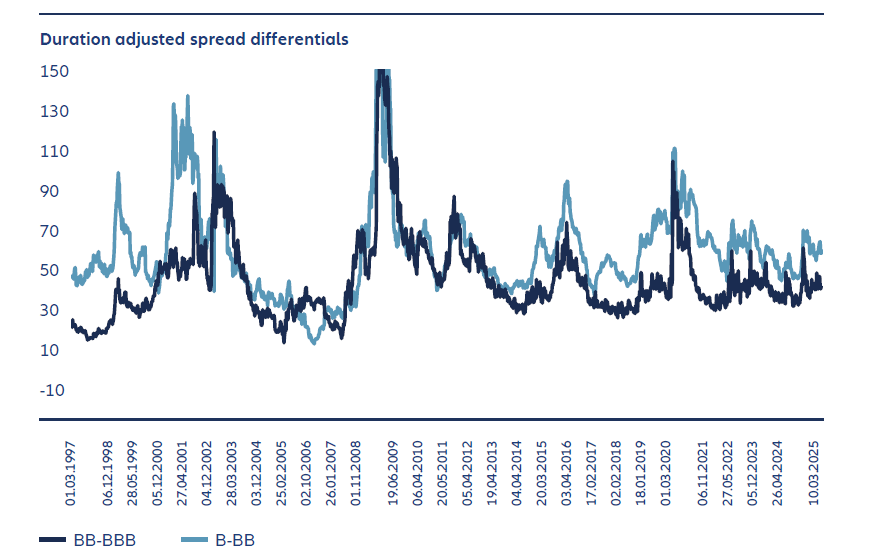
Exhibit 1: US high yield bonds’ duration-adjusted credit spread differential

Source: Allianz Global Investors, ICE indices as at 31 December 2025


3. Most high yield issuance will be refinancing supporting technicals; M&A and fallen angels could provide opportunities

We expect the continuing of a trend in which the majority of high yield debt issuance will be for refinancing – a positive technical for investors. In addition, markets are expecting that funding for mergers, acquisitions (M&A) and leveraged buyouts will increase, bringing more supply to the market, and hopefully some additional yield as these will be new issuers.

It's worth noting that M&A often involves larger (investment grade) companies buying smaller ones which are sometimes high yield. This may create a positive dynamic for high yield investors: target companies tend to see bond prices rise and, if they do become investment grade, this also reduces supply in the market, providing a positive technical.

The wildcard is fallen angels – former investment-grade issuers that have been downgraded to high-yield status. A few names have been well flagged, but we believe other big names might enter the market too. As we saw with Warner Brothers this year, and Pemex, Occidental and Petrobras in the past, these bonds usually trade independently of the broader market and do not lead to a major repricing of other issuers in the index. Indeed, historically fallen angels have provided outsized returns for high yield investors – there are typically more sellers than buyers given that the investment grade market is about ten times the size of the high yield one.

We think refinancing needs and the rising appetite for mergers and buyouts will provide a supportive backdrop for high yield bond investors in 2026, while fallen angels could be an extra opportunity.

4. The AI debt boom will impact all bond markets and provide investment opportunities

Funding for artificial intelligence (AI) will account for a large and growing portion of debt finance in 2026. Like the dot-com boom and bubble in the late 1990s and early 2000s, the AI explosion will likely feature winners and losers. Success will partly depend on the availability of funding – in the early 2000s, many defaults resulted from liquidity drying up before projects were completed.

In the short term, the growth in AI-related debt will principally affect US investment grade bonds (JP Morgan predicts USD 1.81 trillion of US investment-grade issuance in 2026, with AI a key driver). However, high yield, leveraged loans, private debt and equity will also be involved. A side impact of the expected issuance is a likely increase in correlation between markets.

Overall, we think 2026 will prove the importance of asset selection to identify those borrowers with competitive products and an ability to manage liabilities.

5. LMEs have reduced defaults but underscore the need for active credit selection

Defaults as of 31 December 2025 for global high yield stood at 1.5%, almost entirely within CCC-rated bonds – the lowest main category of the high yield market. Our research team estimates a default rate in 2026 of about 2%, again focused in CCCs. This compares with a long-term average of 4.5%.

There is an argument that the default landscape for high yield has structurally changed. We have already noted that the US index is higher in quality. However, in the last few years we have also seen a change in how companies deal with financial stress – namely the rising use of liability management exercises (LMEs), in which a company or active group of creditors propose a proactive solution to a liquidity crisis ahead of time.

LMEs have been enabled by increasingly weak bond and loan covenants that allow various techniques to provide preferential terms for providers of new money compared with existing creditors. While LMEs may stave off imminent defaults, many of the companies that use these techniques go on to default within a couple of years. To put it simply, LMEs are likely to keep defaults subdued but also lead to lower recovery rates.

LMEs have rewritten the rules of investing. In the past, investors could opt for structurally senior or short-dated bonds to provide themselves with some protection in stressed situations, but this is no longer necessarily the case. There is increasing discussion about whether creditors can defend their interests by cooperating with other lenders, with the latest twist being allegations that these kinds of measures are akin to a cartel.

In this uncertain environment, we think that buying stressed credits and hoping for the best is unlikely to be a successful strategy. From an investing perspective, this should underscore a more defensive, active management style. While this approach could lead to periods of underperformance in strongly rallying markets, we believe that in an increasingly litigious market, fuelled by weak covenants, the downside risks are far greater.

6. Know what you don’t know – stay global, active and diversified

The return forecasts quoted above – 6.2% for US high yield with a range from 5% to 8.5% – are based on low defaults, a slight drop in interest rates and reasonable economic growth with little geopolitical risk. Yet one lesson we learnt from 2025 is that nothing is predictable. A casual read of the world press suggests more unpredictability in 2026. In this uncertain environment, we continue to advocate a global approach to investing to take advantage of differences in global growth, central bank policies, local industry dynamics and the widest range of potential investments. This, we believe, is the best way to generate resilient income within global high yield.

1 Source: AllianzGI analysis of predictions from Goldman Sachs, Morgan Stanley, Deutsche Bank, Citi, BNP Paribas and UBS.

Investing involves risk. The value of an investment and the income from it may fall as well as rise and investors might not get back the full amount invested.

Past performance does not predict future returns. If the currency in which the past performance is displayed differs from the currency of the country in which the investor resides, then the investor should be aware that due to the exchange rate fluctuations the performance shown may be higher or lower if converted into the investor’s local currency.

This is for information only and not to be construed as a solicitation or an invitation to make an offer to buy or sell any securities. The views and opinions expressed herein, which are subject to change without notice, are those of the issuer or its affiliated companies at the time of publication. The data used is derived from various sources and assumed to be accurate and reliable at the time of publication. but it has not been independently verified; its accuracy or completeness is not guaranteed and no liability is assumed for any direct or consequential losses arising from its use, unless caused by gross negligence or willful misconduct. The duplication, publication, extraction or transmission of the contents, irrespective of the form, is not permitted, except for the case of explicit permission by Allianz Global Investors.

This material has not been reviewed by any regulatory authorities.


This document is being distributed by the following Allianz Global Investors companies: In Australia, this material is presented by Allianz Global Investors Asia Pacific Limited (“AllianzGI AP”) and is intended for the use of investment consultants and other institutional/professional investors only, and is not directed to the public or individual retail investors. AllianzGI AP is not licensed to provide financial services to retail clients in Australia. AllianzGI AP is exempt from the requirement to hold an Australian Foreign Financial Service License under the Corporations Act 2001 (Cth) pursuant to ASIC Class Order (CO 03/1103) with respect to the provision of financial services to wholesale clients only. AllianzGI AP is licensed and regulated by Hong Kong Securities and Futures Commission under Hong Kong laws, which differ from Australian laws; in the European Union, by Allianz Global Investors GmbH, an investment company in Germany, authorized by the German Bundesanstalt für Finanzdienstleistungs-aufsicht (BaFin) and is authorized and regulated in South Africa by the Financial Sector Conduct Authority; in the UK, by Allianz Global Investors (UK) Ltd. company number 11516839, authorised and regulated by the Financial Conduct Authority (FCA); in Switzerland, by Allianz Global Investors (Schweiz) AG, authorised by the Swiss financial markets regulator (FINMA); in HK, by Allianz Global Investors Asia Pacific Ltd., licensed by the Hong Kong Securities and Futures Commission; in Singapore, by Allianz Global Investors Singapore Ltd., regulated by the Monetary Authority of Singapore [Company Registration No. 199907169Z]; in Japan, by Allianz Global Investors Japan Co., Ltd., registered in Japan as a Financial Instruments Business Operator [Registered No. The Director of Kanto Local Finance Bureau (Financial Instruments Business Operator), No. 424], Member of Japan Investment Advisers Association, the Investment Trust Association, Japan and Type II Financial Instruments Firms Association; In mainland China, it is for Qualified Domestic Institutional Investors scheme pursuant to applicable rules and regulations and is for information purpose only. in Taiwan, by Allianz Global Investors Taiwan Ltd., licensed by Financial Supervisory Commission in Taiwan; and in Indonesia, by PT. Allianz Global Investors Asset Management Indonesia licensed by Indonesia Financial Services Authority (OJK).

5111534

Recent insights

Matt Christensen, Global Head of Sustainable and Impact Investing, highlights the need for greater investment into energy transition solutions, and the potential for investors to participate in this theme - through both private and public market investments.

Discover more

Navigating Rates

We examine the main trends shaping the environment for high yield bonds this year.

Discover more

The global economy enters 2026 bending but not breaking. We expect growth to stay on track, creating an environment that favours risk-taking. Expect a resilient yet complex year where active management will be critical.

DISCOVER NOW

Allianz Global Investors

You are leaving this website and being re-directed to the below website. This does not imply any approval or endorsement of the information by Allianz Global Investors Asia Pacific Limited contained in the redirected website nor does Allianz Global Investors Asia Pacific Limited accept any responsibility or liability in connection with this hyperlink and the information contained herein. Please keep in mind that the redirected website may contain funds and strategies not authorized for offering to the public in your jurisdiction. Besides, please also take note on the redirected website’s terms and conditions, privacy and security policies, or other legal information. By clicking “Continue”, you confirm you acknowledge the details mentioned above and would like to continue accessing the redirected website. Please click “Stay here” if you have any concerns.

Welcome to Allianz Global Investors

Select your language
  • 中文(繁體)
  • English
Select Role
  • Individual Investor
  • Intermediaries
  • Other Investors
  • Pension Investors
  • Allianz Global Investors Fund (“AGIF”)

    • Allianz Global Investors Fund (“AGIF”) as an umbrella fund under the UCITS regulations has within it different Sub-Funds investing in fixed income securities, equities, and derivative instruments, each with a different investment objective and/or risk profile.

    • All Sub-Funds may invest in financial derivative instruments (“FDI”) which may expose to higher leverage, counterparty, liquidity, valuation, volatility, market and over the counter transaction risks. A Sub-Fund’s net derivative exposure may be up to 50% of its net asset value (“NAV”).
      • Some Sub-Funds as part of their investments may invest in any one or a combination of the instruments such as fixed income securities, emerging market securities, and/or mortgage-backed securities, asset-backed securities, property-backed securities (especially REITs) and/or structured products and/or FDI, exposing to various potential risks (including leverage, counterparty, liquidity, valuation, volatility, market, fluctuations in the value of and the rental income received in respect of the underlying property, and over the counter transaction risks).

    • Some Sub-Funds may invest in single countries or industry sectors (in particular small/mid cap companies) which may reduce risk diversification. Some Sub-Funds are exposed to significant risks which include investment/general market, country and region, emerging market (such as Mainland China), creditworthiness/credit rating/downgrading, default, asset allocation, interest rate, volatility and liquidity, counterparty, sovereign debt, valuation, credit rating agency, company-specific, currency (in particular RMB), RMB debt securities and Mainland China tax risks.

    • Some Sub-Funds may invest in convertible bonds, high-yield, non-investment grade investments and unrated securities that may be subject to higher risks (including volatility, loss of principal and interest, creditworthiness and downgrading, default, interest rate, general market and liquidity risks) and therefore may adversely impact the net asset value of the Sub-Funds. Convertibles will be exposed prepayment risk, equity movement and greater volatility than straight bond investments.

    • Some Sub-Funds may invest a significant portion of the assets in interest-bearing securities issued or guaranteed by a non-investment grade sovereign issuer (e.g. Philippines) and is subject to higher risks of liquidity, credit, concentration and default of the sovereign issuer as well as greater volatility and higher risk profile that may result in significant losses to the investors.

    • Some Sub-Funds may invest in European countries. The economic and financial difficulties in Europe may get worse and adversely affect the Sub-Funds (such as increased volatility, liquidity and currency risks associated with investments in Europe).

    • Some Sub-Funds may invest in the China A-Shares market, China B-Shares market and/or debt securities directly via the Stock Connect or the China Interbank Bond Market or Bond Connect or other foreign access regimes and/or other permitted means and/or indirectly through all eligible instruments and thus is subject to the associated risks (including quota limitations, change in rule and regulations, repatriation of the Sub-Fund’s monies, trade restrictions, clearing and settlement, China market volatility and uncertainty, China market volatility and uncertainty, potential clearing and/or settlement difficulties, change in economic, social and political policy in the PRC and Mainland China tax risks).

    • Some Sub-Funds may adopt the following strategies, Socially Responsible Investment (Proprietary Scoring) Strategy, SDG-Aligned Strategy, Sustainability Key Performance Indicator Strategy (Relative), Green Bond Strategy, Multi Asset Sustainable Strategy, Sustainability Key Performance Indicator Strategy (Absolute Threshold), Environment, Social and Governance (“ESG”) Score Strategy, and Sustainability Key Performance Indicator Strategy (Absolute). The Sub-Funds may be exposed to sustainable investment risks relating to the strategies (such as foregoing opportunities to buy certain securities when it might otherwise be advantageous to do so, selling securities when it might be disadvantageous to do so, and/or relying on information and data from third party ESG research data providers and internal analyses which may be subjective, incomplete, inaccurate or unavailable and/or reducing risk diversifications compared to broadly based funds). Also, some Sub-Funds may be particularly focusing on the greenhouse gas emissions (“GHG”) efficiency of the investee companies rather than their financial performance. These may have an adverse impact on the performance of the Sub-Funds.

    • Some Sub-Funds may invest in share class with fixed distribution percentage (Class AMf). Investors should note that fixed distribution percentage is not guaranteed. The share class is not an alternative to fixed interest paying investment. The percentage of distributions paid by these share classes is unrelated to expected or past income or returns of these share classes or the Sub-Funds. Distribution will continue even the Sub-Fund has negative returns and may adversely impact the net asset value of the Sub-Fund. Positive distribution yield does not imply positive return.

    • Investment involves risks that could result in loss of part or entire amount of investors’ investment.

    • In making investment decisions, investors should not rely solely on this [website/material].


    Note: Dividend payments may, at the sole discretion of the Investment Manager, be made out of the Sub-Fund’s capital or effectively out of the Sub-Fund’s capital which represents a return or withdrawal of part of the amount investors originally invested and/or capital gains attributable to the original investment. This may result in an immediate decrease in the NAV per share and the capital of the Sub-Fund available for investment in the future and capital growth may be reduced, in particular for hedged share classes for which the distribution amount and NAV of any hedged share classes (HSC) may be adversely affected by differences in the interests rates of the reference currency of the HSC and the base currency of the respective Sub-Fund, particularly if such HSC are applying the IRD Neutral Policy. Dividend payments are applicable for Class A/AM/AMg/AMi/AMgi/AQ Dis (Annually/Monthly/Quarterly distribution) and for reference only but not guaranteed. Positive distribution yield does not imply positive return. For details, please refer to the Sub-Fund’s distribution policy disclosed in the offering documents.


    Allianz Global Investors Asia Fund

    • Allianz Global Investors Asia Fund (the “Trust”) is an umbrella unit trust constituted under the laws of Hong Kong pursuant to the Trust Deed. Allianz Thematic Income and Allianz Selection Income and Growth and Allianz Yield Plus Fund are the sub-funds of the Trust (each a “Sub-Fund”) investing in fixed income securities, equities and derivative instruments, each with a different investment objective and/or risk profile.

    • Some Sub-Funds are exposed to significant risks which include investment/general market, company-specific, emerging market, creditworthiness/credit rating/downgrading, default, volatility and liquidity, valuation, sovereign debt, thematic concentration, thematic-based investment strategy, counterparty, interest rate changes, country and region, asset allocation risks and currency (such as exchange controls, in particular RMB), and the adverse impact on RMB share classes due to currency depreciation.

    • A Sub-Fund may invest in asset-backed securities (“ABS”) and mortgage-backed securities (“MBS”) which may be highly illiquid and prone to substantial price volatility. These instruments may be subject to greater general market risk, concentration risk, credit and counterparty default risk, liquidity risk and interest rate risk compared to other debt securities.

    • Some Sub-Funds may invest in high-yield (non-investment grade and unrated) investments and convertible bonds which may be subject to higher risks, such as volatility, creditworthiness, default, interest rate changes, general market and liquidity risks and therefore may adversely impact the net asset value of the Sub-Fund.

    • All Sub-Funds may invest in financial derivative instruments (“FDI”) which may expose to higher leverage, counterparty, liquidity, valuation, volatility, market and over the counter transaction risks. The use of derivatives may result in losses to the Sub-Funds which are greater than the amount originally invested. A Sub-Fund’s net derivative exposure may be up to 50% of its net asset value (“NAV”).

    • These investments may involve risks that could result in loss of part or entire amount of investors’ investment.

    • In making investment decisions, investors should not rely solely on this website.

    Note: Dividend payments may, at the sole discretion of the Investment Manager, be made out of the Sub-Fund’s income and/or capital which in the latter case represents a return or withdrawal of part of the amount investors originally invested and/or capital gains attributable to the original investment. This may result in an immediate decrease in the NAV per distribution unit and the capital of the Sub-Fund available for investment in the future and capital growth may be reduced, in particular for hedged share classes for which the distribution amount and NAV of any hedged share classes (HSC) may be adversely affected by differences in the interests rates of the reference currency of the HSC and the base currency of the Sub-Fund, particularly if such HSC are applying the IRD Neutral Policy. Dividend payments are applicable for Class A/AM/AMg/AMi/AMgi Dis (Annually/Monthly distribution) and for reference only but not guaranteed. Positive distribution yield does not imply positive return. For details, please refer to the Sub-Fund’s distribution policy disclosed in the offering documents.


Please indicate you have read and understood the Important Notice.